
Table of Contents
Key Takeaways
| Key Takeaway |
|---|
| The UAE's used-car market is growing at a rapid pace and Toyota remains the single most re-exported brand in that volume. |
| Toyota used cars in Dubai are prized abroad because UAE registration, climate, and dealer-servicing standards keep vehicles in exceptionally clean mechanical condition. |
| The most exported Toyota models are the Hilux, Land Cruiser, Prado, Fortuner, and Hiace, workhorses favored across Africa, the Middle East, and Asia-Pacific. |
| Exporting legally requires an Emirates ID, original Mulkiya (registration card), a customs export certificate, a bill of lading, and destination-country compliance documents (age limits, emissions rules, RHD/LHD restrictions). |
| Costs typically include purchase price, RTA de-registration fees, inspection charges, freight (RoRo or container), insurance, and destination customs duty, and these vary widely by country. |
| Working with a licensed, RTA-approved export company like Car Export 360 removes most of the compliance risk and paperwork burden from the buyer. |
Are you planning to buy a used Toyota in the UAE and ship it abroad? That's indeed a smart move. The UAE's used-car market is projected to grow from $20.55 billion in 2025 to $35.78 billion by 2030 (11.7% CAGR). (Source) However, exporting a used Toyota out of the Emirates isn't as simple as buying a car and shipping it, there's a maze of registration checks, customs codes, destination-country rules, and documentation that can trip up even seasoned buyers. Having a clear idea of the entire process is vital before you commit.
Looking to invest in the used Toyota cars in Dubai and export them to your home country? This blog breaks down everything a first-time or repeat buyer needs to know before sourcing.
Why Is the UAE the World's Leading Hub for Toyota Used Car Exports?
Dubai and Abu Dhabi don't just sell cars; they recycle the region's wealth into a global logistics engine. Several structural advantages make the UAE nearly unbeatable as an export origin:
• Geographic position: Located at the crossroads of Africa, Asia, and Europe, with direct shipping lanes to over 120 countries.
• World-class ports: Jebel Ali (the largest man-made harbor in the world) and Khalifa Port, built specifically to handle high-volume RoRo (Roll-on/Roll-off) vehicle shipments.
• A "trade-in" culture: UAE has a unique culture where residents replace vehicles every 2-4 years, constantly refreshing export inventory with low-mileage, well-maintained stock.
• A large expat and rental-fleet turnover: Hundreds of thousands of rental and lease vehicles exit UAE fleets annually, entering the resale and export pipeline in near-new condition.
• Free zones and simplified re-export policies: The free zones let trading companies move vehicles with minimal domestic tax friction.
Why Are Toyota Used Cars in Dubai So Popular Among Global Exporters?
Ask any exporter which brand moves fastest off the yard, and the answer is almost always Toyota.
There are three overlapping reasons Toyota cars dominate export manifests:
• Unmatched parts availability worldwide: Even in remote parts of Africa or Central Asia, a Toyota mechanic and a Toyota part are rarely far away.
• Engineering built for extremes: Toyota's UAE-spec vehicles are already tuned for high heat and dust, ideal for buyers in similarly harsh climates.
• Resale value retention: Toyota consistently posts some of the strongest depreciation curves in the used market, meaning importers can resell at a profit even after freight and duty.
Buyers in West Africa, East Africa, the GCC, and South Asia specifically search Dubai's export yards first because the combination of low mileage, full-service history, and GCC-spec durability simply isn't available at the same price point anywhere else.
What Makes UAE-Sourced Toyota Vehicles Reliable for Export?
It isn't marketing; it's math. UAE vehicles genuinely tend to arrive at export yards in better mechanical shape than cars from many other origin markets, for a few concrete reasons:
• Mandatory annual RTA inspections: Such inspections catch structural, safety, and emissions issues early.
• Dealer-network servicing culture: Most owners service at authorized Toyota centers (Al-Futtaim in the UAE), which means digital service records are traceable.
• Minimal rust exposure: The UAE's dry desert climate means little to no corrosion, a major differentiator versus vehicles from cold, salted-road markets.
• Lower average annual mileage: The country boasts a low mileage where fuel is inexpensive but commute distances are moderate and roads are excellent.
• Fewer accident-repair histories: Relative to markets with harsher winter driving conditions, the accidents are less here.
| Factor | UAE-Sourced Toyota | Typical Cold-Climate Market Import |
|---|---|---|
| Rust/corrosion risk | Very low | Moderate to high |
| Avg. service documentation | Strong (dealer network) | Variable |
| Climate stress on rubber/seals | High heat exposure (manageable) | Freeze-thaw cycles (harder on parts) |
| Accident history (salt/ice related) | Rare | More common |
| Resale value retention | Strong | Moderate |
Beyond climate and servicing, there's a structural reason UAE-sourced Toyota vehicles tend to outperform vehicles from many other origin markets: the sheer volume of turnover. Because a large share of UAE residents are expatriates on renewable visas and employment contracts, vehicle ownership cycles are shorter than in many home-ownership-heavy markets. Cars are frequently sold not because they've reached the end of their useful life, but because an owner is relocating, upgrading, or transitioning between lease and personal ownership. That means export yards are constantly refreshed with vehicles that have plenty of mechanical life left in them, a very different dynamic from markets where used cars typically change hands only once they're already showing significant wear.
Which Toyota Models Are Exported the Most from UAE?
Not every Toyota model performs equally in the export market. Some are built specifically with export markets in mind, heavy-duty suspension, simpler electronics, and diesel engine options that are hard to find in other regions. Take a look at the Toyota car models that are highly in demand!
| Model | Typical Export Markets | Why It's in Demand |
|---|---|---|
| Toyota Hilux | Africa, Middle East, Pacific | Legendary durability, low-maintenance diesel engines |
| Toyota Land Cruiser (LC70/200/300) | Africa, Middle East, Central Asia | Off-road capability, NGO/government fleet favorite |
| Toyota Land Cruiser Pick-Up | Africa, Middle East | Rugged workhorse for commercial and agricultural use |
| Toyota Prado | GCC, South Asia, Africa | Family SUV comfort with serious off-road ability |
| Toyota Fortuner | South Asia, Southeast Asia, Africa | Balance of comfort, reliability, and resale value |
| Toyota Hiace | Africa, South Asia | Commercial and passenger transport backbone |
| Toyota Corolla / Camry | Africa, Caribbean, Central America | Affordable, easy-to-source parts, fuel efficient |
According to recent regional market reporting, exporters are increasingly focused on exactly this list: Hilux, Hiace, Fortuner, and Land Cruiser Pick-Up units in particular, as the high-volume core of the outbound Toyota trade to Africa and Asia.
What Documents Do You Need to Export a Used Toyota from UAE?
This is where most first-time buyers underestimate the process. Missing even one document can delay a shipment for weeks at the port.
Here's the standard checklist:
• Original Mulkiya (vehicle registration card)
• Passport copy and Emirates ID of the buyer or the export company acting on their behalf
• Purchase invoice / sales agreement
• Customs export declaration issued by UAE Customs
• RTA de-registration certificate (vehicle must be officially removed from the UAE road registry before export)
• Certificate of origin (sometimes required by the destination country)
• Bill of lading from the shipping line once cargo is booked
• Destination-country import permit or pre-shipment inspection certificate, where applicable (some African and GCC-neighboring countries require this before the vehicle even leaves Dubai)
• Insurance documentation for the shipment
Buyers sourcing Toyota used cars in Dubai for the first time are strongly advised to confirm destination-country rules before purchase, some countries restrict vehicle age (commonly 5, 8, or 10 years), engine size, or left/right-hand drive configuration, and a car that can't legally be imported at the destination is a very expensive mistake.
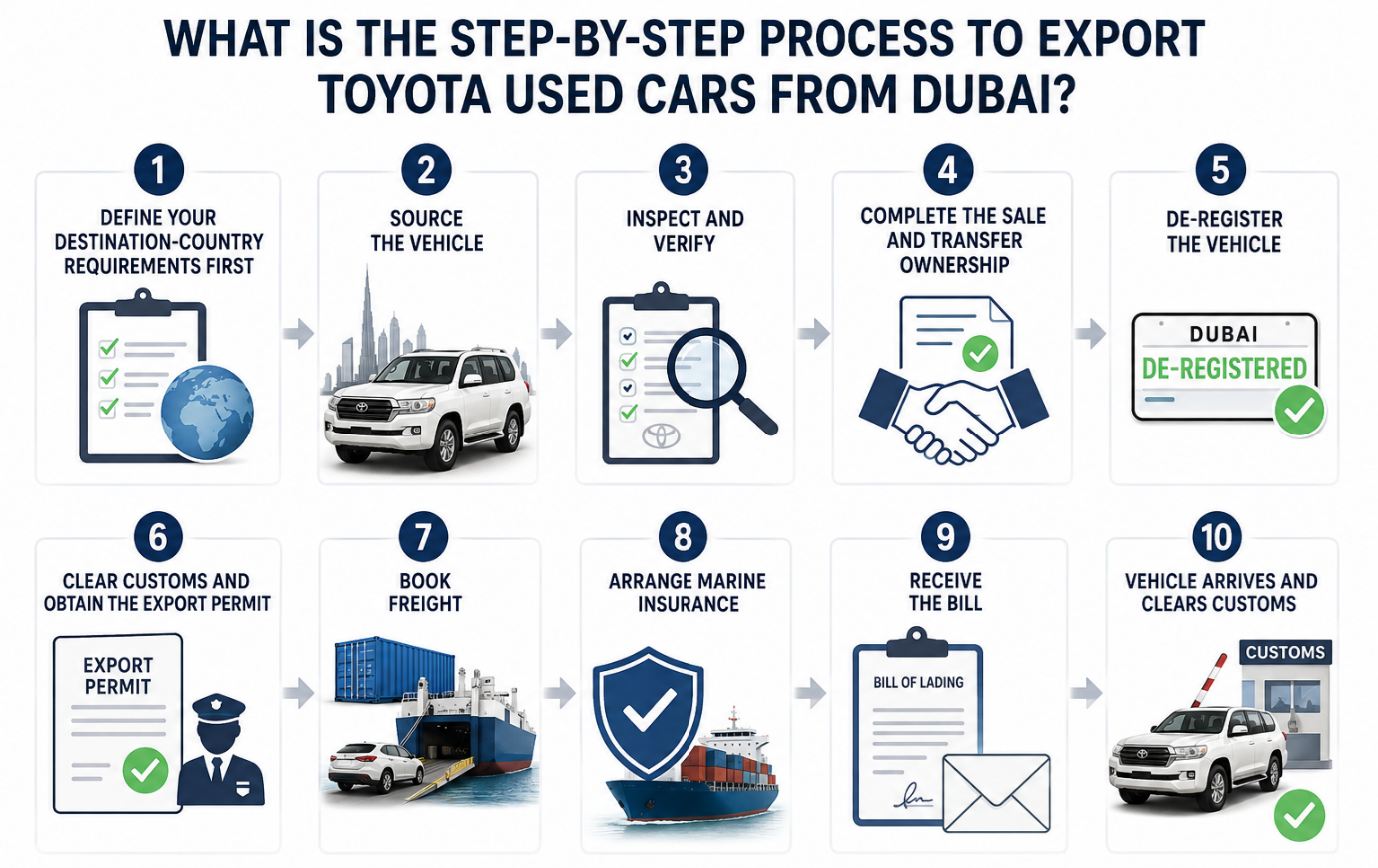
What Is the Step-by-Step Process to Export Toyota Used Cars from Dubai?
When it comes to exporting Toyota used cars from Dubai or anywhere across the UAE, having an idea of the complete process matters. Take a look at the different steps involved in the process!
1. Define your destination-country requirements first: Check age limits, emissions standards, and RHD/LHD rules before you shop.
2. Source the vehicle: Buy directly, at a UAE auction, or more commonly for overseas buyers, through a licensed export company that sources on your behalf.
3. Inspect and verify: A pre-purchase inspection (mechanical, structural, accident history via a VIN/chassis check) protects against buying a salvage-title or flood-damaged unit.
4. Complete the sale and transfer ownership: Ensure completion of these processes through the RTA.
5. De-register the vehicle: This is mandatory before export and generates the de-registration certificate customs will require.
6. Clear customs and obtain the export permit.
7. Book freight: Container shipping (safer, costs more) or RoRo (Roll-on/Roll-off, cheaper, faster turnaround).
8. Arrange marine insurance: Get insurance for the voyage.
9. Receive the bill: Obtain the bill of lading and forward shipping documents to the buyer/importer at destination.
10. Vehicle arrives and clears customs: In the destination country, the importer will have to local duties and completes local registration.
What Does It Cost to Export a Toyota Used Car from the UAE?
Costs will undoubtedly vary based on the car model, destination, and shipping method, but here's a realistic breakdown buyers should budget for when sourcing Toyota used cars in Dubai:
| Cost Component | Typical Range (Indicative) | Notes |
|---|---|---|
| Vehicle purchase price | Varies by model/year | Biggest line item |
| RTA de-registration fee | Small fixed fee | Mandatory before export |
| Pre-export inspection | Modest fixed fee | Highly recommended, not always mandatory |
| Freight - RoRo | Lower cost | Fastest, most common for SUVs/pickups |
| Freight - Container (20ft/40ft) | Higher cost | Better protection, allows multiple vehicles or added cargo |
| Marine insurance | Percentage of vehicle value | Protects against transit damage/loss |
| Destination customs duty & taxes | Varies dramatically by country | Can range from low single digits to 100%+ of vehicle value in some markets |
| Local registration at destination | Varies by country | Paid by the importer, not the UAE exporter |
The single biggest variable most buyers often overlook is destination customs duty, some African nations levy modest import taxes, while certain markets apply steep age-based penalties on older vehicles. Always confirm landed cost (vehicle + freight + duty) before committing, not just the UAE purchase price.
Which Countries Import the Most Toyota Used Cars from Dubai?
The UAE's re-export network reaches well over 100 countries, but demand for Toyota used cars in Dubai concentrates heavily in a handful of regions:
• East & West Africa - Kenya, Tanzania, Uganda, Nigeria, Ghana (Hilux, Land Cruiser, Corolla)
• Central Asia & the Caucasus - Georgia, Kyrgyzstan, Kazakhstan (Prado, Land Cruiser, Camry)
• South Asia - Pakistan, Afghanistan, Bangladesh (Hiace, Fortuner)
• The wider GCC and Levant - re-export and cross-border trade within the region
• Pacific Islands - Fiji, Papua New Guinea (Hilux, Land Cruiser)
• Caribbean & Central America - Jamaica, Guyana, Dominican Republic (Corolla, Camry, RAV4)
Japanese-origin and GCC-spec vehicles broadly dominate these corridors precisely because of the reliability-per-dollar equation and within that Japanese-brand dominance, Toyota is consistently the top-moving nameplate out of the UAE.
It's worth noting that demand from individual corridors can shift quickly based on local policy changes. A country tightening age restrictions on imports, adjusting duty rates, or restricting right-hand-drive vehicles can see its import volumes swing sharply within a single quarter. Buyers and importers who track these regulatory shifts rather than assuming last year's rules still apply are far better positioned to time their purchases and avoid vehicles arriving at a port only to be rejected or hit with unexpected duty. This is one of the most underrated reasons to work with an exporter that maintains active relationships across multiple destination markets, since that on-the-ground awareness of shifting rules rarely shows up in a simple online search.
What Challenges Do Exporters Commonly Face?
Even with the UAE's efficient infrastructure, buyers regularly run into friction points:
• Changing destination-country import laws as age limits and duty structures shift with little warning, a vehicle compliant today may not be next quarter.
• Odometer and accident-history discrepancies on vehicles bought without proper inspection.
• Currency and payment-transfer delays, especially for buyers in countries with capital controls.
• Port congestion and freight schedule delays during peak shipping seasons.
• Incomplete documentation causing customs hold-ups at either end.
• Working with unlicensed "brokers" who take payment but lack proper RTA/customs accreditation.
Most of these problems are avoidable, but only if they're anticipated before money changes hands. Currency delays, for instance, can often be sidestepped by using an exporter that accepts staged payments tied to shipment milestones rather than demanding full payment upfront. Port congestion is largely seasonal and predictable freight rates and vessel availability tend to tighten around major holiday periods and year-end, so buyers working to a tight delivery deadline should build in extra lead time. And the unlicensed-broker problem, unfortunately still common in this industry, is best solved simply by verifying credentials before transferring any funds rather than after a shipment goes missing.
What Should You Inspect Before Finalizing a Toyota Export Purchase?
A clean-looking vehicle photo is not the same as a mechanically sound car. So, before committing to any unit whether you're buying in person or remotely through an export company, insist on verification of the following:
• Chassis/VIN check: against UAE records to confirm the vehicle hasn't been reported stolen, salvaged, or flood-damaged.
• Odometer consistency: cross-checked against service history records, not just the dashboard reading.
• Engine and transmission inspection: including a cold-start check and a test drive if the vehicle is being purchased in person.
• Undercarriage and frame inspection: for accident repair welds or structural damage.
• Air conditioning system performance: critical for both UAE resale and for buyers in equally hot destination climates.
• Tire condition and matching brand/size: since mismatched tires can be a red flag for suspension issues.
• Full service history documentation: ideally from an authorized Toyota (Al-Futtaim) service center.
• Photo and video documentation: dated at the time of inspection, not recycled listing photos.
A reputable exporter will provide this documentation proactively, without being asked twice. If a seller is reluctant to share service records or allow an independent inspection, treat that as a warning sign rather than a minor inconvenience.
How Do You Choose the Right Exporter for Toyota Used Cars in Dubai?
Because so much can go wrong in the paperwork chain, the exporter you choose matters more than the vehicle itself. Look for:
• RTA and UAE customs accreditation: Ask for license numbers, not just a website.
• Transparent, itemized pricing: Vehicle cost, fees, freight, and insurance quoted separately, not bundled into a vague total.
• In-house inspection capability: Ideally with photo/video documentation and a VIN history check.
• A track record of shipping to your specific destination country: since import rules differ so much market to market.
• Real customer reviews and verifiable shipping history: Ask for reviews of real customers and not just testimonials on the company's own site.
• Responsive, documented communication: You want tracking updates in writing, not verbal promises.
What Do Industry Experts Say About This Market?
Regional automotive analysts tracking the UAE's used-vehicle sector describe it as a market entering a genuinely new growth phase, driven by rising re-export demand, a wave of near-new rental-fleet vehicles entering resale, and rapid growth in online used-car sales channels. Analysts covering the H1 2025 period specifically noted that export-side demand stayed concentrated on durable, high-volume Toyota models: the Hilux, Hiace, Fortuner, and Land Cruiser Pick-Up, because international buyers consistently prioritize reliability and region-tested inventory over novelty.
Final Word
The demand for Toyota used cars in Dubai isn't just a passing trend; it's built on decades of engineering reputation, a regional climate and service culture that keeps vehicles in exceptional condition, and one of the most efficient export infrastructures on the planet. But the paperwork, compliance, and logistics chain genuinely determine whether that demand turns into a smooth, profitable purchase or a costly, delayed headache.
Ready to source your next Toyota for export the right way? Talk to the Car Export 360 team for a transparent quote, a licensed sourcing and inspection process, and end-to-end shipping support tailored to your destination country.
FAQs
1. Can any foreign buyer legally purchase and export a used Toyota from the UAE?
Yes. There's no residency requirement to buy a used vehicle for export, though the transaction and de-registration are typically processed through a licensed export company or dealer acting on the buyer's behalf.
2. How long does it take to export a Toyota from Dubai after purchase?
On average, it takes about 1-3 weeks from purchase to vessel departure, depending on de-registration processing time, freight booking availability, and destination-country pre-shipment requirements. Transit time then depends on the shipping route.
3. Is RoRo or container shipping better for exporting a used Toyota?
RoRo is usually cheaper and faster to book, and works well for SUVs and pickups like the Hilux or Land Cruiser. Container shipping costs more but offers better protection against weather and handling damage, and allows consolidating multiple vehicles or additional cargo in one shipment.
4. Are there age restrictions on the used Toyota I can import into my country?
Many countries do restrict vehicle age, commonly 5, 8, or 10 years from manufacture, and some also restrict engine size or emissions class. Therefore, it is always wise to confirm your destination country's current rules before purchasing, since these regulations change periodically.
5. What's the biggest mistake first-time buyers make when exporting Toyota used cars in Dubai?
Skipping a pre-purchase inspection and assuming all UAE cars are automatically in perfect condition. While UAE-sourced vehicles are generally well maintained, individual units can still have accident history or mechanical issues, an independent inspection and VIN check remove that risk.
6. Does Car Export 360 handle the full export process, or just the vehicle sourcing?
Car Export 360 manages the full pipeline: sourcing, inspection, RTA de-registration, customs clearance, freight booking, and documentation, so buyers don't have to coordinate multiple vendors themselves.