

Table of Contents
Key Takeaways
| Key Takeaway |
|---|
| Car export to America from UAE is legal but tightly regulated. Vehicles must clear both U.S. Customs and Border Protection (CBP) and satisfy separate EPA and DOT requirements before they can be driven on U.S. roads. |
| Vehicle age is the single biggest factor. Cars that are 25 years old or older (measured from the manufacture date, not the model year) are exempt from DOT safety standards, and vehicles 21 years or older are generally exempt from EPA emissions rules. |
| Newer, non-U.S.-spec vehicles face a harder path. Cars under 25 years that were never built to U.S. federal standards typically need modification through an EPA-registered Independent Commercial Importer (ICI), which adds significant time and cost. |
| Documentation errors are the leading cause of delay. Missing bills of lading, incomplete HS-7 or EPA 3520-1 forms, or unclear proof of ownership can hold a shipment at port for weeks. |
| RoRo (Roll-on/Roll-off) shipping is usually the most cost-effective method, while container shipping offers more security and is often preferred for high-value or classic vehicles. |
| The UAE's re-export ecosystem is genuinely significant. |
| Working with an experienced UAE-based export company can meaningfully reduce the paperwork burden and the risk of costly customs holds on the U.S. side. |
The UAE has quietly become one of the world's busiest crossroads for vehicle trade, and increasingly, that traffic runs both ways. Trade data shows the UAE exported roughly $367 million worth of cars globally in a recent year, reflecting its role as a major regional vehicle trade hub. (Source) While most of the attention goes to American cars arriving in Dubai and Abu Dhabi, a smaller but steadily growing number of vehicles are making the opposite journey: from the UAE to the United States. Classic cars, GCC-spec exotics, and low-mileage luxury vehicles all move through this corridor, but the process involves a very different rulebook than shipping in the other direction, one built around U.S. Customs, EPA emissions standards, and DOT safety requirements rather than UAE registration rules. This blog will delve into what that process involves, from legal eligibility and documentation to shipping methods, realistic costs, and the mistakes that most often slow a shipment down.
Why Does the UAE Matter for the U.S. Car Trade?
The United Arab Emirates has spent the last two decades building one of the world's most active vehicle trading hubs. Jebel Ali Port, one of the largest man-made harbors on earth, sits at the center of this ecosystem, connecting Gulf, African, Asian, and increasingly, North American buyers and sellers.
A few things make the UAE a genuinely important node in global vehicle trade:
• Low-mileage, well-maintained stock: Strict road conditions, mandatory servicing culture, and a climate that (despite the heat) avoids the rust and corrosion common in colder markets means UAE-registered vehicles often present in excellent mechanical condition.
• A re-export free zone advantage: Jebel Ali operates as a free trade zone, which simplifies the documentation chain for vehicles moving onward to other countries, including the United States.
• Access to GCC-spec and limited-edition models: Many manufacturers release Gulf-spec trims, special editions, and performance variants that were never sold in North America, which is a major draw for American collectors and enthusiasts.
• A mature logistics network: Freight forwarders, customs brokers, and RoRo shipping lines operating out of the UAE have deep experience moving vehicles internationally, which shortens the learning curve for first-time exporters.
Which Vehicle Categories Perform Best for US-Bound Export?
Not every vehicle is an equally strong candidate for car export to America from UAE. In practice, three categories dominate this trade:
| Category | Why It Works Well | Typical Buyer |
|---|---|---|
| Classic and vintage vehicles (25+ years old) | Exempt from most federal safety/emissions compliance, making the process faster and cheaper | Collectors, restoration enthusiasts |
| GCC-spec exotics and limited editions | Trims, colors, and special editions not sold in North America | Enthusiasts, dealers specializing in rare imports |
| Well-documented, low-mileage luxury vehicles | Strong condition and service history support resale value | Private buyers, specialty dealerships |
Newer, mass-market vehicles that were never built to U.S. specification are technically exportable, but they usually require the most compliance work and offer the thinnest cost-benefit margin. This is one reason it helps to work with a partner who has handled a genuine car export to America from UAE before, not just regional shipments, since they can flag early whether a given vehicle is a strong candidate or a costly one.
A quick way to sanity-check a vehicle before committing to export:
• Check the manufacture date, not just the model year, against the compliance label or original registration documents.
• Confirm whether the model was ever sold in the U.S. If it was, DOT/EPA compliance is usually far simpler.
• Estimate resale demand in the U.S. market before shipping, especially for niche or limited-production vehicles.
• Get a written cost estimate that separates freight, customs, and any compliance work, so there are no surprises later in the process.
What Documents Do You Need for Car Export to America from UAE?
Documentation is where most delays happen. Before your vehicle is booked onto a vessel, make sure you have the following ready:
On the UAE (export) side:
• Original vehicle registration card (Mulkiya)
• UAE Customs export certificate
• Certificate of Origin (if requested by the buyer or broker)
• Bill of Sale / commercial invoice
• Passport copy of the exporter/owner
• Deregistration certificate from the UAE traffic authority
On the U.S. (import) side:
• Bill of Lading (B/L) or Air Waybill (AWB)
• DOT HS-7 Declaration Form
• EPA Form 3520-1 (Declaration of importation of motor vehicles and engines)
• CBP Entry Form 7501
• Proof of ownership and vehicle age (invoice, registration, or historical society letter)
• Importer Security Filing (ISF), filed at least 24 hours before the vessel departs the foreign port
• Packing list (if spare parts or accessories are shipped inside the vehicle)
A simple way to think about it: the UAE side proves you legally own and can export the car; the U.S. side proves the car is legally allowed to enter. Missing either half stalls the shipment.
How Does the Shipping Process Actually Work?
Car export to America from UAE generally follows six stages:
1. Vehicle inspection and valuation: The exporter or a third-party inspector documents the car's condition, VIN, mileage, and existing damage, this becomes your reference point if a dispute arises later.
2. Booking and documentation: The freight forwarder books space on a vessel and begins preparing the export paperwork listed above.
3. UAE customs clearance and port delivery: The vehicle is delivered to Jebel Ali Port (or another approved UAE port) and cleared for export.
4. Ocean transit: Depending on the shipping line and route, transit from the UAE to major U.S. ports (commonly New York/New Jersey, Baltimore, Savannah, or Los Angeles/Long Beach) typically takes several weeks.
5. U.S. arrival and customs entry: CBP, EPA, and DOT review the paperwork and may physically inspect the vehicle, this is where the 25-year rule (or lack of it) determines how smooth this stage is.
6. Release and delivery: Once cleared, the vehicle is released to the importer or forwarded to an inland trucking company for final delivery.
RoRo vs. Container Shipping: Which One Should You Choose?
This is one of the most common questions exporters ask, and the right answer depends on the vehicle's value, condition, and your budget.
| Factor | RoRo (Roll-on/Roll-off) | Container Shipping |
|---|---|---|
| Cost | Generally lower | Generally higher |
| Security | Vehicle is exposed to weather and handling during loading | Vehicle is enclosed and locked |
| Best for | Standard sedans, SUVs, everyday vehicles | Classic cars, exotics, high-value or modified vehicles |
| Extra cargo | Not possible (RoRo only carries the vehicle) | Can include spare parts, tools, or accessories |
| Loading method | Driven on and off the vessel under its own power | Loaded via crane, often on a wheeled platform |
A practical rule of thumb: If the car runs and drives and isn't a high-value collector's item, RoRo is usually the more economical choice. If you're exporting a classic, an exotic, or anything irreplaceable, the extra cost of a container is often worth the added protection.
How Much Does It Cost to Export a Car from UAE to the USA?
Costs vary significantly based on vehicle size, shipping method, destination port, and vehicle age (because of the compliance pathway required). Below is a general breakdown of the cost categories you should budget for; always confirm current rates with your shipping line and broker, since freight rates fluctuate.
| Cost Category | What It Covers |
|---|---|
| Ocean freight | The core shipping cost, varies by port pair, vessel type, and vehicle size |
| UAE export documentation & customs | Local clearance, certificate of origin, port handling |
| U.S. customs duty | Passenger cars generally attract a modest base duty; commercial vehicles differ |
| Harbor Maintenance Fee | A small percentage fee applied to ocean shipments arriving at U.S. ports |
| Merchandise Processing Fee | A standard CBP processing fee on the customs entry |
| EPA/DOT compliance (if applicable) | Costs for ICI modification, testing, or Registered Importer services for vehicles under the exemption thresholds |
| Inland trucking (U.S. side) | Delivery from the port of entry to the final destination |
| State registration & inspection | Varies by state; some states (like California, New York, and Massachusetts) apply stricter emissions and safety checks |
How Long Does the Whole Process Take?
A realistic timeline for car export to America from UAE looks something like this:
• Documentation preparation: 1-3 weeks (faster if all UAE paperwork is already in order)
• Port-to-port ocean transit: Typically 3-6 weeks, depending on the shipping line, vessel schedule, and destination port
• U.S. customs clearance: A few days to two weeks for straightforward, compliant vehicles; considerably longer for vehicles requiring EPA/DOT modification
• Inland delivery: A few days to a week, depending on distance from the port
Total realistic window:
Roughly 6 to 12 weeks for a straightforward, compliant (or exempt) vehicle, and potentially several months longer for a newer, non-U.S.-spec vehicle that requires ICI modification.
Things to Consider When Exporting Cars from UAE to America
Before booking freight or signing an export agreement, it helps to work through a short list of decision points. Getting these right upfront is what separates a smooth car export to America from UAE from one that stalls at customs or costs far more than expected. None of these considerations are complicated on their own, but overlooking even one of them is usually what turns a routine shipment into a delayed or expensive one.
#1 Does the Vehicle Qualify for an Age-Based Exemption?
The single biggest factor in how easy and affordable your export will be is vehicle age. U.S. federal rules exempt vehicles that are 25 years old or older (measured from the actual manufacture date, not the model year) from DOT safety standards, and vehicles 21 years or older from most EPA emissions requirements. If your car falls outside these thresholds and was never built to U.S. specification, it will likely need modification through an EPA-registered Independent Commercial Importer before it can legally enter the country: a process that adds meaningful time and cost. Confirming where your vehicle sits against these thresholds should be the very first thing you check, before you commit to shipping.
#2 Was the Vehicle Ever Built to U.S. Specification?
Some GCC-market vehicles share a platform with a U.S.-spec equivalent, which can simplify compliance considerably even outside the age exemptions. Others, particularly Gulf-exclusive trims, special editions, or vehicles with region-specific engine and emissions tuning, were never certified for the U.S. market at all. It's worth checking this before export, since it directly affects whether your vehicle has a realistic, cost-effective path to entry.
#3 Is the Vehicle's Title and Ownership History Clean?
A vehicle with a clear, lien-free title and a documented ownership history moves through both UAE export clearance and U.S. customs entry far more smoothly than one with gaps or disputes in its paper trail. Before committing to export, confirm that:
• The Mulkiya (UAE registration) is current and free of outstanding fines
• There are no bank liens or finance holds on the vehicle
• Service history and any accident records are available, particularly for buyers evaluating classic or exotic vehicles
#4 What's Your Realistic Total Budget, Not Just the Freight Quote?
Freight is usually only part of the total cost. A realistic budget should also account for UAE export documentation and customs fees, U.S. customs duty, port fees, any EPA/DOT compliance work if the vehicle doesn't qualify for an exemption, inland trucking once the vehicle reaches the U.S., and state-level registration and inspection costs. Exporters who budget only for ocean freight are frequently surprised by the cumulative weight of these secondary costs.
#5 Which US Port and Destination State Fit Your Situation?
Not all U.S. ports and states are equally straightforward. Consider:
• Port proximity to the final destination: This affects inland trucking cost and time.
• State-level emissions and safety rules: States like California, New York, and Massachusetts apply stricter requirements than others, which can matter even after federal clearance is complete.
• Vessel schedules and sailing frequency: which vary by shipping line and can affect how predictable your timeline is.
#6 RoRo or Container - Which Fits This Specific Vehicle?
This isn't a one-size-fits-all decision. A daily-driver sedan or SUV is usually well served by RoRo shipping, which tends to be more affordable. A classic, exotic, or otherwise irreplaceable vehicle is often better protected in an enclosed container, even at a higher cost. Matching the shipping method to the vehicle's value, rather than defaulting to whichever is cheapest, avoids unnecessary risk on higher-value shipments.
#7 How Much Timeline Flexibility Do You Actually Have?
A straightforward, exemption-qualifying vehicle can realistically move from UAE port departure to U.S. delivery in six to twelve weeks. A vehicle requiring EPA/DOT modification can take considerably longer, sometimes several additional months. If you're working against a hard deadline: a sale, an event, or a relocation, it's worth building in buffer time rather than assuming the fastest-case timeline will hold.
#8 Do You Have Reliable Support on Both Ends of the Shipment?
Because this process touches UAE export authorities, an international shipping line, and three separate U.S. federal agencies, it rarely goes smoothly without experienced help on both sides. Before booking, it's worth confirming that your UAE-based forwarder has genuine experience with U.S.-bound shipments specifically, and, if you're not handling U.S. customs entry yourself, that you have a licensed customs broker or importer of record lined up on the receiving end.
#9 Have You Verified the Export Company's Credentials?
This trade lane, like most cross-border vehicle trade, attracts its share of unreliable operators alongside legitimate ones. Before signing an agreement, verify the exporter's trade license, look for independently sourced reviews rather than relying on their own testimonials, and be cautious of anyone requesting full payment upfront through informal channels rather than a documented contract.
#10 Have You Planned for What Happens After Customs Clearance?
Clearing U.S. federal customs is a milestone, not the finish line. Once the vehicle is released, it still needs inland transport to its final destination, state-level title and VIN verification, and, depending on the state, a separate safety or emissions inspection before it can be legally registered and insured. Planning for this final stretch in advance, rather than treating federal clearance as the end of the process, avoids a last-minute scramble once the car actually reaches American soil.
Taken together, these considerations are less about any single rule and more about building an accurate picture of the vehicle, the paperwork, the budget, and the people handling the shipment, before the car ever reaches the port.
What Are the Most Common Mistakes Exporters Make?
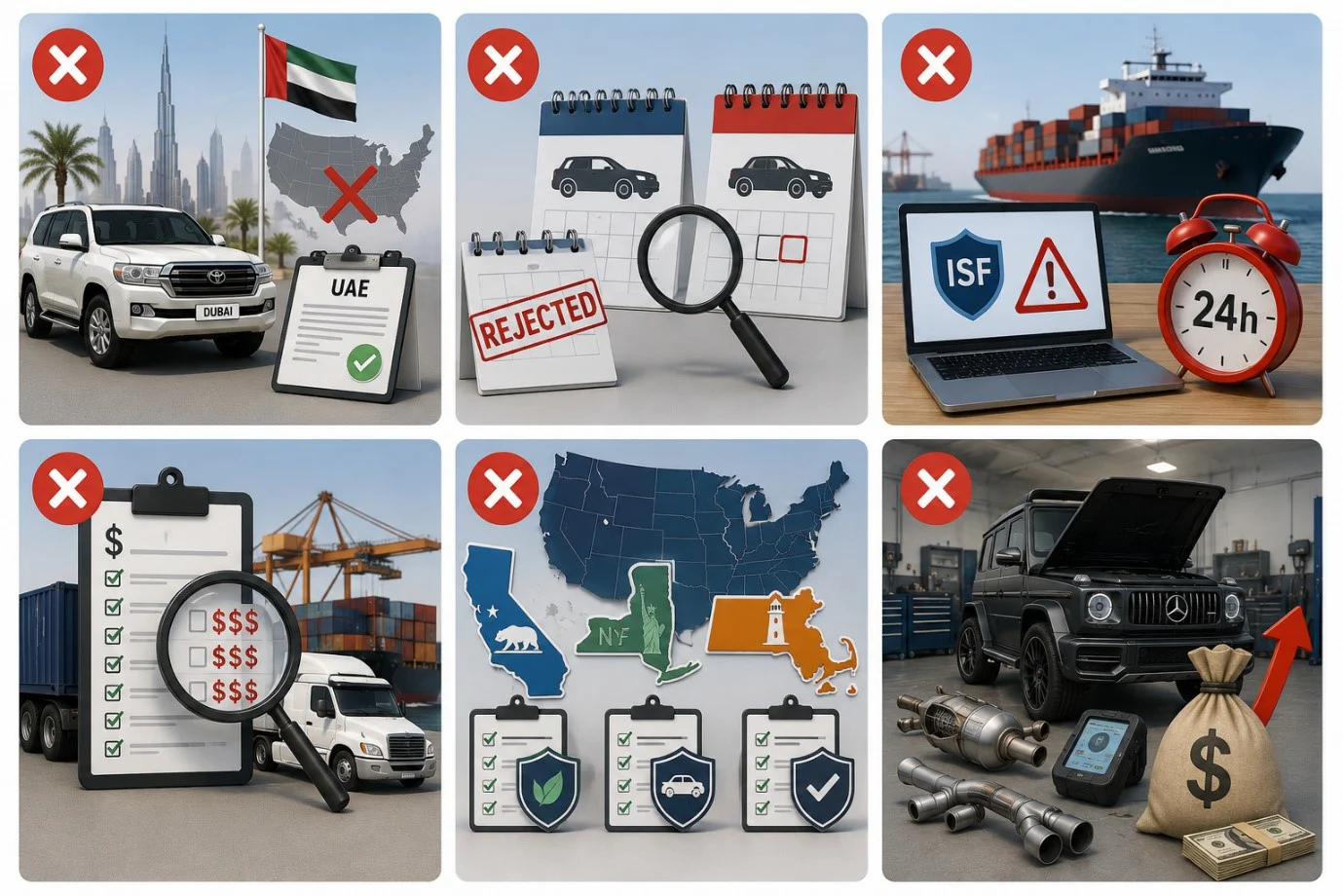
• Assuming "it's legal in the UAE, so it's fine for the US.": UAE registration has no bearing on U.S. EPA/DOT eligibility.
• Miscalculating vehicle age: Using the model year instead of the actual manufacture date can lead to a rejected HS-7 declaration.
• Skipping the Importer Security Filing (ISF): Missing this 24-hour pre-departure filing can result in penalties or shipment holds.
• Choosing the cheapest freight quote without checking what's included: Some quotes exclude port handling, documentation, or inland delivery, leading to unexpected costs later.
• Not verifying state-specific rules: Federal clearance does not automatically guarantee state registration, states like California, New York, and Massachusetts apply their own, often stricter, emissions and safety requirements.
• Underestimating modification costs for newer vehicles: If a vehicle doesn't qualify for the age exemptions, ICI modification and testing can be a substantial, sometimes vehicle-value-changing, expense.
How Do You Choose a Reliable Export Partner in the UAE?
Because so much of this process depends on precise, correctly sequenced paperwork, the exporter or forwarder you work with matters as much as the shipping line itself.
When evaluating a UAE-based export partner, consider asking:
• Do they have documented experience specifically with U.S.-bound shipments (not just Africa or the wider GCC)?
• Can they walk you through the HS-7 and EPA 3520-1 requirements clearly, without vague reassurances?
• Do they provide a transparent, itemized cost breakdown before booking?
• Do they offer tracking or regular status updates during ocean transit?
• Can they connect you with a licensed U.S. customs broker on the receiving end, or do you need to arrange one independently?
• Are they able to advise on whether your specific vehicle qualifies for the 25-year exemption, or whether it will need EPA/DOT modification?
A transparent partner will tell you upfront if a vehicle is a poor candidate for export to the U.S. For example, a newer non-U.S.-spec vehicle where modification costs could exceed the value gained from the export, rather than only focusing on booking the shipment.
What Happens After the Car Arrives in the US?
Clearing federal customs is not the final step. Once your vehicle is released by CBP:
1. Inland transport moves the vehicle from the port to its final destination, either by open or enclosed car carrier.
2. State-level registration and inspection begins, which is separate from federal clearance. Requirements vary widely; some states require only a basic safety inspection, while others (particularly those with strict emissions programs) require additional testing.
3. Title and VIN verification at the local DMV, often requiring the original foreign title, the CBP entry documents, and proof of the federal exemption or compliance.
4. Insurance setup, which typically requires the vehicle to already be titled or in the process of being titled in the importer's name.
Because state requirements differ so much, it's worth checking your destination state's DMV or motor vehicle authority website before the vehicle even leaves the UAE, so there are no surprises at the registration counter.
Final Thoughts
Car export to America from UAE is a well-established, legal process, but it rewards preparation. The exporters who move vehicles through smoothly are almost always the ones who understand the 25-year rule, assemble complete documentation before the vehicle reaches the port, and choose a shipping method that matches the value of what they're moving. The ones who run into expensive delays are usually the ones who treat U.S. customs clearance as an afterthought.
If you're planning a car export to America from UAE and want a clearer picture of what your specific vehicle will require, whether that's confirming exemption eligibility, understanding documentation, or comparing RoRo and container options, the team at Car Export 360 is happy to walk you through the process. Get in touch with Car Export 360 today to discuss your vehicle's export requirements and get a clear, transparent breakdown of what to expect.
Frequently Asked Questions
1. Can anyone do a car export to America from UAE, or do you need a license?
Individuals can legally export a personally owned vehicle from the UAE and import it into the U.S., provided they complete the required UAE export paperwork and U.S. entry forms (HS-7, EPA 3520-1, CBP 7501). You don't need a special "importer license" for a single personal vehicle, though working through an experienced freight forwarder or customs broker significantly reduces the risk of paperwork errors.
2. Do all cars qualify for the 25-year exemption?
No. The exemption applies specifically to the vehicle's age from its manufacture date, 25 years for DOT safety standards and 21 years for EPA emissions rules. A car that is, say, 15 years old will generally not qualify unless it was originally built to U.S. federal specifications.
3. Is RoRo shipping safe for expensive or classic cars?
RoRo shipping is generally safe and widely used, but the vehicle is exposed to the elements and handled by port staff during loading and unloading. For high-value, rare, or classic vehicles, many exporters prefer enclosed container shipping for the added protection, even though it costs more.
4. Which U.S. ports commonly receive vehicle shipments from the UAE?
Common U.S. entry ports for vehicles shipped from the UAE include New York/New Jersey, Baltimore, Savannah, and the Los Angeles/Long Beach port complex, though the exact routing depends on the shipping line and vessel schedule.
5. Does federal customs clearance mean the car is automatically registered in my state?
No. Federal clearance through CBP, EPA, and DOT only allows the vehicle to legally enter the country. Registering and titling the vehicle is a separate, state-level process, and requirements, especially around emissions and safety inspections, vary significantly from state to state.
6. What's the biggest factor that determines cost and timeline?
Vehicle age relative to the 25-year (DOT) and 21-year (EPA) thresholds is by far the biggest factor. Exempt vehicles move through customs faster and more cheaply, while newer, non-U.S.-spec vehicles requiring EPA/DOT modification take considerably longer and cost more.